Showing posts with label Slovakia. Show all posts

Bardejov

December 06, 2025

Bardejov is a small but exceptionally complete and well-preserved example of a fortified medieval town, which typifies the urbanisation in this region. Among other remarkable features, it also contains a small Jewish quarter around a fine 18th-century synagogue.

Unesco: Bardejov Town Conservation Reserve
RR: Unesco RR
Date: Nov 20

Church of St. Francis of Assisi

May 12, 2025

The Roman Catholic wooden church of St. Francis of Assisi, made of red spruce, was built at the end of the 15th century in the Gothic style. It is situated on a small elevation in the centre of the village of Hervartov. Since 2008 it has been included in the list of UNESCO monuments. It is the oldest and one of the best preserved wooden churches in Slovakia. The church is enclosed by a stone wall with pilasters, which gives visitors the impression of a small fortress. The sacral building consists of a polygonal sanctuary, a nave, a sacristy and an undercroft, which has been modified to create a granary. The church also includes a bell tower. Since 1968 the wooden church in Hervartov has been a national cultural monument. Together with other wooden churches of the Carpathian Arch, it was inscribed on the UNESCO World Heritage List in 2008.

Unesco: Wooden Churches of the Slovak part of the Carpathian Mountain Area
RR: Unesco RR
Date: April 27

Gombasek Cave

March 13, 2025

Gombasek Cave is a karst cave located in the Slovak Karst National Park, in the Slaná river valley. Since 1995, the Gombasek Cave is included in the UNESCO World Heritage List as a part of the Caves of Aggtelek Karst and Slovak Karst site because of its exemplary speleothems and its record of karst formation under varying conditions, including periods of glaciation and temperate, and tropical climatic conditions.

Unesco: Caves of Aggtelek Karst and Slovak Karst
RR: 10x10 RR
Date: March 3

Gerulata

June 12, 2024

Gerulata was a Roman military camp located near today's Rusovce, a borough of Bratislava. It was part of the Roman province of Pannonia and was built in the 2nd century as a part of the frontier defence system. Today there is a museum, which is part of the Bratislava City Museum. Archaeologists have unearthed its remnants and their discoveries are on exhibition in the hall of the museum. Beyond the remains of the Roman forum, fragments of structures and gravestones, bronze, iron, ceramic and stone pieces are on show in a museum showing daily life. The best preserved object is a quadrilateral building 30 metres long and 30 metres wide, with 2.4 metre thick walls. In 2021, Gerulata was added to the UNESCO's World Heritage List as part of the Western segment of the Danubian Limes of the Roman Empire.

Unesco: Frontiers of the Roman Empire – The Danube Limes (Western Segment) 
RR: Unesco
Date: June 2

Levoča

April 02, 2024

The historic town Levoča, situated in the east of the Spiš region, is a true cultural and historic jewel among the Slovak towns as it possesses a great number of architectural monuments linked with the glorious past of the town. The town has a historic center with a well-preserved town wall, a Gothic church with the highest wooden altar in the world and many other Renaissance buildings. UNESCO cites the town's historic center, its fortifications, and the works of Master Paul of Levoča preserved in the town.

Unesco: Levoča, Spišský Hrad and the Associated Cultural Monuments
RR: Unesco RR
Date: March 24

Ochtinská Aragonite Cave

January 07, 2024

Ochtinská Aragonite Cave is a unique aragonite cave situated in southern Slovakia, near Rožňava. Although only 300 m long, it is famous for its rare aragonite formations. Along with other caves of the Slovak Karst, it is included in the UNESCO World Heritage list as a component of Caves of Aggtelek Karst and Slovak Karst site, because of its diversity of aragonite formations and testimony to the cave-forming geologic processes. The Ochtinská Aragonite Cave is one of only three aragonite caves discovered in the world so far. In the so-called Milky Way Hall, the main attraction of the cave, white branches and clusters of aragonite shine like stars in the Milky Way. 

Unesco: Caves of Aggtelek Karst and Slovak Karst
RR: Unesco RR
Date: Dec 27

Bardejov


The town of Bardejov is located in north-eastern Slovakia, on a floodplain terrace of the river Topľa near the Polish border. Bardejov is a small but exceptionally complete and well-preserved example of a fortified medieval town, which typifies the urbanisation in this region. The historic core of the town is encircled by the fortification system which was, at the time of its construction, one of the most advanced in Central Europe. Among other remarkable features, it also contains a small Jewish quarter around a fine 18th-century synagogue. 

Unesco: Bardejov Town Conservation Reserve
RR: Unesco RR
Date: dec 27

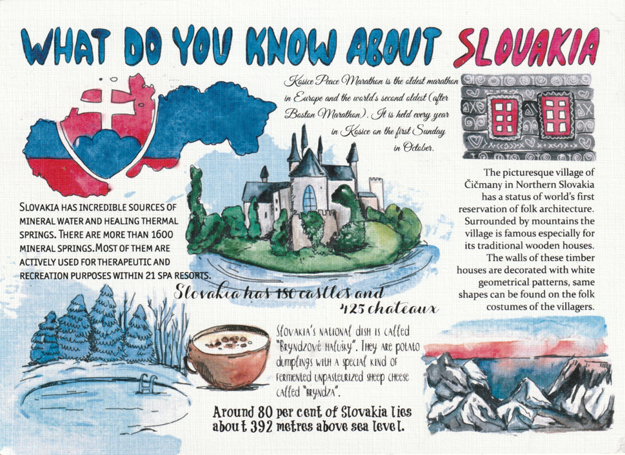
What do you know about Slovakia

January 08, 2022

What do you know about Slovakia, country with 150 castles and 425 chateaux, the oldest marathon in Europe, over 1600 mineral springs and the village of Čičmany, the world's first reserve of folk architecture.

Thanks a lot Milan!
Date: Dec 28

Banská Štiavnica

January 04, 2022

Banská Štiavnica  is a completely preserved medieval townin central Slovakia.  The old medieval mining centre grew into a town with Renaissance palaces, 16th-century churches, elegant squares and castles. The urban centre blends into the surrounding landscape, which contains vital relics of the mining and metallurgical activities of the past.

Unesco: Historic Town of Banská Štiavnica and the Technical Monuments in its Vicinity
RR: Unesco RR
Date: Dec 21

Bratislava Castle

November 18, 2020

Bratislava Castle is the main castle of Bratislava, the capital of Slovakia. The massive rectangular building with four corner towers stands on an isolated rocky hill of the Little Carpathians directly above the Danube river in the middle of Bratislava. Because of its size and location, it has been a dominant feature of the city for centuries. The location provides excellent views of Bratislava, Austria and, in clear weather, parts of Hungary. Many legends are connected with the history of the castle. The northern border of the site is formed by a long Baroque building from the 18th century, which today houses the Slovak National Museum and the castle administration.

Distance: 970 km
Travel time: 9 days

Flags of the World - Slovakia

November 09, 2020

The Slovak flag consists of white upper strip, the middle is blue and bottom red. These colors are conventional Slavonic shades. They symbolize Slavonic harmony and independence. The double cross represents Christian tradition and memory of St. Cyril and St. Methodius, the two missionaries who came to Great Moravia in 863 to strengthen Chritianity. They created the first alphabet to be used for Slavonic manuscripts and wrote the first Slavic Civil Code, which was used in Great Moravia. The three hills represent Tatra, Matra and Fatra mountains.

Thanks a lot Martin!
Date: Oct 25

Orava Castle


Orava Castle, is situated on a high rock above Orava river in the village of Oravský Podzámok, Slovakia. It is considered to be one of the most beautiful castles in Slovakia and belongs to the most important monuments of castle architecture in Slovakia and stands as a landmark of Orava region

Distance: 1,055 km
Travel time: 22 days

Wooden articular church of Hronsek

September 06, 2020

Wooden articular church of Hronsek is a Lutheran church situated in the village of Hronsek, in Slovakia. The church is in the form of cross with the longer arm measuring 23 m and the shorter arm measuring 18 m. The height of the church is 8 m. The church  was declared UNESCO world heritage site in 2008.

Unesco: Wooden Churches of the Slovak part of the Carpathian Mountain Area (2008)
RR: Vacation RR #1651
Date: Aug 25

Bratislava

August 28, 2020

From Bratislava, the capital and largest city of Slovakia. A beautiful view of the city and Bratislava Castle, the main castle of Bratislava. The massive rectangular building with four corner towers stands on an isolated rocky hill of the Little Carpathians directly above the Danube river in the middle of Bratislava. Because of its size and location, it has been a dominant feature of the city for centuries.

Thanks again Martina!
Date: Aug 13

CCUN - Slovakia


CCUN Slovakia, showing the ruins of Spiš Castle, an UNESCO site and one of the largest castle sites in Central Europe. Spiš Castle was built in the 12th century on the site of an earlier castle. It was the political, administrative, economic and cultural centre of Szepes County of the Kingdom of Hungary.

Thanks a lot Martina!
Date: Aug 13

Spiš Castle


The ruins of Spiš Castle is one of the largest castle sites in Central Europe. The castle is situated above the town of Spišské Podhradie and the village of Žehra that with adjacent ecclesiastical town Spišská Kapitula form components of the UNESCO World Heritage site. Its bulwarks and thick defensive walls date to the 12th century (at the latest), and once guarded Hungarian royals and nobles from flying arrows. Highlights of the four-hectare site, connected by stony pathways and stairs, include views from the 22m-high tower, and a museum of medieval history within the former palace.

Thanks a lot for this interesting card Martina!
Unesco: Levoča, Spišský Hrad and the Associated Cultural Monuments
Date: Aug 13

Greetings from... Slovakia

July 16, 2020

Greetings from Slovakia, a landlocked country in Central Europe. It is bordered by Poland to the north, Ukraine to the east, Hungary to the south, Austria to the southwest, and Czech Republic to the northwest. The Slovak landscape is noted primarily for its mountainous nature, with the Carpathian Mountains extending across most of the northern half of the country.

Thanks a lot Martina
Date: June 22

Vlkolínec

June 16, 2020

Vlkolínec, situated in the centre of Slovakia, is a remarkably intact settlement of 45 buildings with the traditional features of a central European village. It is the region’s most complete group of these kinds of traditional log houses, often found in mountainous areas.
Vlkolínec has been listed as a UNESCO World Heritage site since 1993, and is one of ten Slovak villages that have been given the status of a folk architecture reservations. This status was granted because the village is an untouched and complex example of folk countryside architecture of the region of the Northern Carpathians.

Thanks so much Katarina
Unesco: Vlkolínec
Date: June 2

Vlkolínec

May 11, 2020

Vlkolínec, situated in the centre of Slovakia, is a remarkably intact medieval settlement of 45 buildings with the traditional features of a central European village. It is the region’s most complete group of these kinds of traditional log houses, often found in mountainous areas. Its layout, defined in part by the hilly terrain of the mountains of Veľká Fatra, features log houses situated on narrow lots with stables, barns and smaller outbuildings in the rear. Vlkolínec has been listed as a UNESCO World Heritage site since 1993, and is one of ten Slovak villages that have been given the status of a folk architecture reservations. This status was granted because the village is an untouched and complex example of folk countryside architecture of the region of the Northern Carpathians.

Unesco: Vlkolínec
Distance: 1,234 km
Travel time: 20 days

St. Elisabeth Cathedral


The St. Elisabeth Cathedral in Košice. The building of Košice Cathedral started after the original Romanesque-Gothic church burned down in 1378. It was completed after various alterations in 1508.  The Cathedral's present-day form dates from the great reconstruction between 1877 and 1896. The current renovation project has been under way since 1978.
It is Slovakia's largest church and one of the easternmost Gothic cathedrals in Europe.

Distance: 1,234 km
Travel time: 20 days